
Key Takeaways
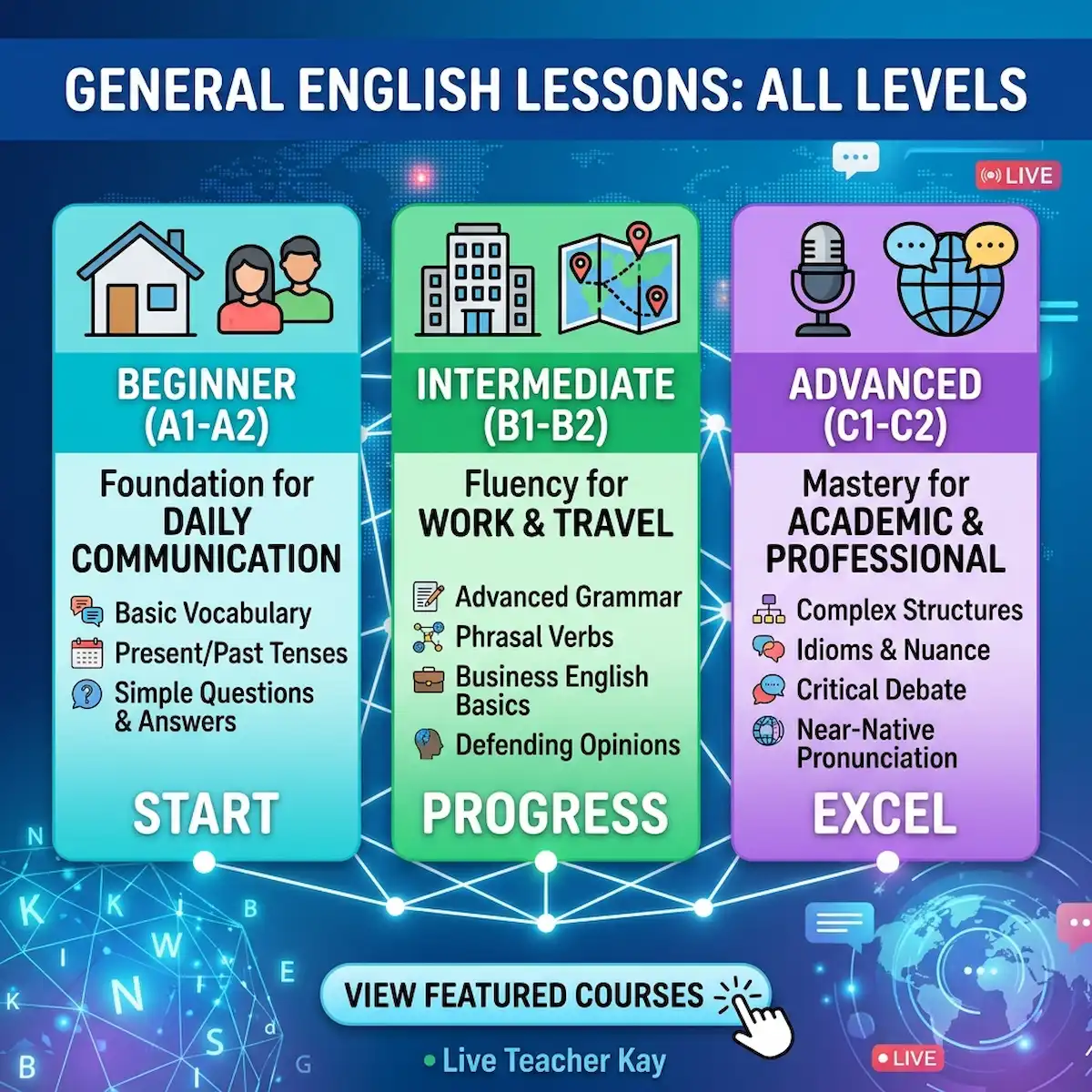
- How are general English lessons structured across different skill levels? Programs divide into three distinct tracks aligned with the Common European Framework of Reference for Languages (CEFR): Beginner (A1–A2), Intermediate (B1–B2), and Advanced (C1–C2), ensuring students never sit in mixed-ability rooms that stall speaking progress.
- How many hours of study does it take to move up one proficiency level? Cambridge Assessment English research shows that moving from one CEFR band to the next requires roughly 200 guided learning hours combined with consistent self-study.
- Why do most self-study language learners plateau at the intermediate stage? Passive mobile applications train recognition rather than active production, leaving over half of global adult learners weak in spontaneous speaking skills according to the EF English Proficiency Index.
- What happens in live classes on live.englishteacherkay.net? Students participate in real-time, small-group or one-on-one sessions led by American English instructor Teacher Kay, focusing on phonemic accuracy, functional syntax, and unscripted conversation.
- Can students join live lessons from a smartphone? Yes, learners can connect seamlessly from both Android and iPhone devices using standard mobile browsers or dedicated video conferencing apps with a stable broadband or 5G connection.
Why Do So Many Students Struggle to Find Effective General English Lessons?
Most adult language learners stall out not because they lack talent, but because they spend months memorizing isolated vocabulary lists inside gamified apps instead of practicing real-time spoken interaction. Across 123 non-English-speaking countries and regions tracked by the EF English Proficiency Index, speaking consistently ranks as the weakest skill for more than half of all test-takers. Meanwhile, randomized controlled trials compiled by the National Bureau of Economic Research demonstrate that structured live tutoring produces a pooled learning gain of +0.37 standard deviations—nearly four times the median effect size of standard educational interventions. When you click through to the featured courses on live.englishteacherkay.net, you are stepping away from passive screen tapping and entering a tiered curriculum built around measurable speech production, American English pronunciation mechanics, and clear grammatical progression.
Tuton+ 1
CEFR proficiency progression from A1 to C2. Source: Cambridge English
The core problem with one-size-fits-all language courses is cognitive overload at the bottom and boredom at the top. Put a true beginner in a room full of intermediate speakers, and their affective filter shoots through the roof—they freeze up, stop taking verbal risks, and drop out within three weeks. Put an advanced professional in a generic conversation club, and they spend sixty minutes repeating the same three hundred comfort-zone words without ever fixing fossilized grammar errors. Separating general English lessons into three strict proficiency tiers solves both problems simultaneously by matching input difficulty just slightly above your current comprehension threshold, a principle linguists call comprehensible input plus one.
In my own teaching work, the turning point for almost every hesitant speaker happens the moment they stop treating English like a written school exam and start treating it like a physical coordination skill. You cannot learn to swim by reading a manual on fluid dynamics, and you cannot master spoken rhythm by tapping multiple-choice bubbles on a train commute. Every module inside our live courses pairs explicit structural rules with immediate, corrected vocal output so your mouth and ear build muscle memory together.
How Does the CEFR Framework Guide Your Placement in General English Lessons?
Every syllabus on live.englishteacherkay.net maps directly onto the six-level scale established by the Council of Europe, grouping A1 and A2 into Beginner, B1 and B2 into Intermediate, and C1 and C2 into Advanced. Rather than guessing which class feels right, placement relies on observable communicative benchmarks—what you can actually do under real-time conversational pressure without reaching for a translation dictionary. According to official guided learning hour benchmarks published by Cambridge English, reaching functional independence at B2 takes roughly 500 to 600 cumulative hours from zero, while achieving near-native mastery at C2 requires between 1,000 and 1,200 hours.
Cambridge English Support Site
| Proficiency Tier | CEFR Bands | Cumulative Guided Hours | Active Vocabulary Range | Core Communicative Milestone | Primary Instructional Focus |
|---|---|---|---|---|---|
| Beginner Track | A1 – A2 | 90 – 200 hours | 500 – 1,500 word families | Survive predictable daily transactions, introduce yourself, ask basic questions, and describe past routines | Phonemic awareness, present and past simple tenses, core survival nouns, sentence word order |
| Intermediate Track | B1 – B2 | 350 – 600 hours | 2,500 – 4,500 word families | Handle unexpected travel issues, defend opinions in meetings, narrate complex stories, and grasp main ideas of fast media | Perfect aspect, conditional clauses, phrasal verbs, connected speech reductions, discourse markers |
| Advanced Track | C1 – C2 | 700 – 1,200 hours | 8,000 – 12,000+ word families | Negotiate high-stakes contracts, detect subtle humor and irony, write persuasive briefs, and speak with minimal hesitation | Inversion, mixed conditionals, register shifting, idiomatic nuance, prosody and stress timing |
Inside the language training industry, placement directors look closely at a metric called lexical coverage—the percentage of words in a spoken or written text that a listener already knows. Research in corpus linguistics shows that you need roughly 95 percent lexical coverage to follow a casual conversation comfortably and 98 percent coverage to read unadapted novels or industry reports without constant dictionary lookups. Our three-tier division ensures that the reading passages, listening clips, and role-play prompts in your general English lessons always sit right inside that 95 to 98 percent sweet spot.
Another insider reality that rarely gets mentioned in glossy course brochures is the phenomenon of fossilization. When learners spend years speaking broken English at work without structured correction, mistakes like dropping third-person singular endings or confusing simple past with present perfect harden into permanent habits. Breaking fossilized patterns requires targeted noticing drills where an instructor isolates a single recurring error, models the exact articulatory fix, and drills it inside realistic dialogue until the corrected form becomes automatic.
What Will You Learn in the Beginner General English Lessons Curriculum?
The Beginner curriculum (CEFR A1–A2) builds your spoken foundation from the ground up, focusing on American English phonemic awareness, high-frequency survival vocabulary, and reliable present, past, and future sentence structures. Many adult beginners arrive carrying years of silent reading knowledge from school but freeze when asked a simple question at an airport counter or coffee shop. During the first month of beginner general English lessons, we retrain the ear before the eye—isolating tricky vowel contrasts like the short /ɪ/ in “ship” versus the long /iː/ in “sheep,” alongside consonant clusters that do not exist in many learners’ native languages.
Live interactive instruction builds early speaking confidence. Source: GoStudent
A student from Seoul joined our beginner track after studying grammar textbooks for six years yet refusing to order food in English during a trip to Seattle. Within four weeks of practicing structured role-play scripts and mastering basic question inversion—turning statements like “You are ready” into “Are you ready?”—she recorded herself booking a hotel room over the phone in under two minutes without a single pause to translate in her head. That rapid shift happens because beginners need high-mileage sentence frames they can immediately reuse across dozens of daily situations.
Beginner Curriculum Module Breakdown (Levels A1 to A2)
- Module 1: Sound Foundations and Alphabet Phonics
- Short and long American vowel distinctions, voiced versus unvoiced consonants, and syllable stress rules.
- Numbers, dates, spelling names aloud over the phone, and basic greetings for formal and casual settings.
- Module 2: Present Simple and Daily Routines
- Affirmative, negative, and question forms with “to be” and action verbs.
- Frequency adverbs (always, usually, rarely), telling time, and describing work or study schedules.
- Module 3: Nouns, Quantifiers, and Practical Shopping
- Countable versus uncountable nouns, articles (a, an, the), and quantifiers (some, any, much, many, a lot of).
- Navigating restaurants, grocery stores, currency exchanges, and asking for prices or directions.
- Module 4: Present Continuous and Live Action
- Describing actions happening right now versus permanent habits.
- Weather vocabulary, clothing descriptions, and making immediate phone arrangements.
- Module 5: Past Simple Storytelling
- Regular “-ed” pronunciation endings (/t/, /d/, and /ɪd/) and the 60 most common irregular verbs.
- Narrating weekend activities, past vacations, and childhood memories using time markers.
- Module 6: Future Intentions and Comparisons
- Using “going to” for concrete plans versus “will” for spontaneous decisions and offers.
- Comparative and superlative adjectives for evaluating hotels, transport options, and everyday products.
- Module 7: Modal Verbs for Politeness and Ability
- Using “can” and “could” for requests, “should” for simple advice, and “must” or “have to” for rules.
- Polite versus blunt phrasing in customer service interactions and workplace introductions.
- Module 8: Beginner Capstone Integration
- Fifteen-minute unscripted survival simulation covering airport check-in, doctor visits, and social small talk.
- Diagnostic pronunciation check and readiness review for stepping up to the Intermediate cohort.
Every lesson in this beginner sequence uses visual prompts and Total Physical Response cues rather than dense grammar lectures. Instead of memorizing abstract definitions of prepositions, students physically arrange items on their desk and describe spatial relationships live on camera until “on,” “under,” “next to,” and “between” become reflexive.
How Does the Intermediate General English Lessons Curriculum Break the Fluency Plateau?
The Intermediate curriculum (CEFR B1–B2) targets the exact linguistic bottlenecks that trap learners in the infamous “intermediate plateau,” replacing repetitive basic phrasing with nuanced tense control, high-frequency phrasal verbs, and natural connected speech. At this stage, you can already get your point across in predictable situations, yet native speakers speaking at normal speed still sound like a blur, and your own sentences often feel stiff or overly translated from your first language. Intermediate general English lessons directly attack that gap by teaching how native speakers actually link, reduce, and elide words in real conversation—such as turning “What are you going to do?” into natural spoken rhythm.
Timeline mapping of English verb aspects. Source: English Lessons Brighton
An engineer from Guadalajara entered our intermediate program after getting passed over for a regional team lead role because he struggled to explain project delays clearly during video calls. He knew plenty of technical nouns, yet he consistently mixed up simple past and present perfect, telling executives “We finished the audit yesterday” when the audit was actually still ongoing. After six weeks of targeted timeline drills contrasting finished past actions with unfinished experiences, he led a forty-minute cross-border sprint review entirely in English and secured the promotion the following quarter.
Intermediate Curriculum Module Breakdown (Levels B1 to B2)
- Module 1: Mastering the Perfect Aspect
- Present perfect simple versus simple past for life experiences, recent news, and unfinished time periods.
- Present perfect continuous with “for” and “since” to emphasize duration and visible results.
- Module 2: Narrative Tenses and Storytelling Flow
- Combining past simple, past continuous, and past perfect to sequence complex events clearly.
- Discourse markers (meanwhile, eventually, turns out, all of a sudden) that keep listeners engaged.
- Module 3: Real and Hypothetical Conditionals
- Zero, first, and second conditionals for cause-and-effect rules, realistic negotiations, and hypothetical scenarios.
- Replacing repetitive “if” clauses with “unless,” “as long as,” “provided that,” and “in case.”
- Module 4: Modal Verbs of Deduction and Regret
- Expressing degrees of certainty in the present and past using “must have,” “might have,” and “can’t have”.
- Giving constructive feedback using “should have” and “ought to have” without sounding accusatory.
- Module 5: Passive Voice and Formal Reporting
- Shifting focus from the actor to the action in workplace updates, news reports, and process descriptions.
- Causative structures (“have something done” and “get someone to do something”) for delegating tasks.
- Module 6: Essential Phrasal Verbs and Collocations
- Separable versus inseparable phrasal verbs organized by core particles (up, out, off, over, through).
- High-frequency verb-noun collocations (“make a decision,” “take responsibility,” “meet a deadline”).
- Module 7: Gerunds, Infinitives, and Relative Clauses
- Verbs that change meaning depending on whether they take a gerund or an infinitive (stop, remember, try, regret).
- Defining and non-defining relative clauses to combine short choppy sentences into fluid commentary.
- Module 8: Connected Speech and Debate Workshop
- American English flap T, linking consonants to vowels, and weak forms of function words (to, for, of, can).
- Structured persuasive speaking exercises defending a position, conceding a counterpoint, and summarizing takeaways.
A crucial piece of industry knowledge for intermediate learners involves the Pareto distribution of English vocabulary. While English dictionaries contain over 170,000 words in current use, corpus studies confirm that the top 3,000 word families account for roughly 95 percent of everyday spoken and written discourse. Rather than chasing obscure literary adjectives, intermediate general English lessons focus relentlessly on expanding the deep collocational network around those core 3,000 words—teaching you how a simple verb like “run” shifts meaning across “run a business,” “run out of time,” “run into an old friend,” and “run a diagnostic.”
What Does the Advanced General English Lessons Curriculum Cover for Near-Native Fluency?
The Advanced curriculum (CEFR C1–C2) refines linguistic precision, stylistic register control, rhetorical persuasion, and idiomatic comprehension for learners operating in demanding academic, executive, or international environments. At the advanced threshold, grammatical errors are rare, so instruction shifts toward eliminating subtle unnatural phrasing, mastering implied meaning, and adapting tone effortlessly between a casual lunch with colleagues and a boardroom presentation. Advanced general English lessons challenge students with authentic unedited media, rapid multi-speaker debates, and complex syntactic structures that elevate spoken authority.
A clinical researcher from Zurich joined our advanced cohort before presenting her findings at an international medical symposium in Boston. Her written manuscripts were publication-grade, yet she noticed that native-speaking panelists used subtle hedging language during Q&A sessions to disagree politely without sparking conflict. Over eight weeks of drilling epistemic modality, cleft sentences, and diplomatic disagreement frames, she transformed her live delivery—handling tough audience pushback with poised, idiomatic phrasing that earned invitations to two multi-center research partnerships.
Advanced Curriculum Module Breakdown (Levels C1 to C2)
- Module 1: Advanced Conditionals and Subjunctive Mood
- Third and mixed conditionals for analyzing past decisions and their present consequences.
- Formal mandative subjunctive (“It is vital that she attend”) and inverted conditional clauses (“Had we known earlier”).
- Module 2: Emphasis, Inversion, and Cleft Sentences
- Negative adverbial inversion (“Rarely have I seen,” “Not only did they approve”) for rhetorical impact.
- “It-cleft” and “Wh-cleft” structures to highlight key information during negotiations and speeches.
- Module 3: Nuanced Modality and Diplomatic Hedging
- Softening blunt assertions using tentative verbs, modal adverbs, and distancing phrases.
- Navigating sensitive workplace feedback, contract pushback, and high-stakes conflict resolution.
- Module 4: Idiomatic Mastery and Figurative Language
- Decoding business, political, and cultural idioms in context without overusing clichés.
- Understanding understatement, dry humor, sarcasm, and regional differences between American and British usage.
- Module 5: Participle Clauses and Dense Information Packaging
- Replacing wordy relative and adverbial clauses with crisp present and past participle phrases.
- Writing executive summaries, opinion editorials, and persuasive proposals with zero fluff.
- Module 6: Prosody, Intonation, and Discourse Stress
- Using pitch contour, contrastive stress, and strategic pausing to command attention in meetings.
- Distinguishing polite rising-falling intonation from skeptical or impatient pitch patterns.
- Module 7: Critical Media Analysis and Spontaneous Synthesis
- Listening to rapid-fire podcasts, panel discussions, and unscripted interviews with overlapping speakers.
- Summarizing opposing viewpoints objectively and synthesizing complex arguments under tight time limits.
- Module 8: Advanced Capstone and Executive Simulation
- Leading a thirty-minute moderated roundtable discussion followed by spontaneous press-style questioning.
- Comprehensive linguistic audit evaluating lexical range, syntactic variety, pronunciation clarity, and pragmatic accuracy.
How Do Live General English Lessons Compare to Self-Study Apps and Pre-Recorded Courses?
Choosing between live instructor-led general English lessons, gamified mobile apps, and pre-recorded video libraries comes down to whether you want passive familiarity or active conversational command. According to 2025 and 2026 industry market reports compiled by Mordor Intelligence and Tuton, the global online language learning market reached $21.06 billion in 2025, with English accounting for 54.85 percent of all revenue. Yet data from massive open online courses (MOOCs) reveals a stark completion gap: self-paced video courses suffer completion rates hovering near 3 to 6 percent, whereas structured live tutoring cohorts maintain attendance rates above 90 percent when scheduled consistently.
| Evaluation Criteria | Live General English Lessons (live.englishteacherkay.net) | Gamified Mobile Apps (e.g., Duolingo, Babbel) | Pre-Recorded Video Platforms (e.g., Udemy, Coursera) |
|---|---|---|---|
| Real-Time Speaking Time | High (50–70% student talk time per session) | Very low (automated speech recognition drills only) | Zero (one-way passive video consumption) |
| Error Correction Quality | Immediate, personalized articulatory and grammar feedback | Automated binary pass/fail without explanation | None (learners risk reinforcing fossilized errors) |
| Curriculum Adaptation | Dynamic pacing adjusted to your live performance | Algorithmic repetition of preset vocabulary trees | Fixed linear syllabus regardless of your weak spots |
| Accountability and Retention | High (scheduled live sessions with instructor tracking) | Streak-based notifications that often reward easy review | Very low (average self-paced MOOC completion under 6%) |
| Preparation for Real-World Pressure | Trains spontaneous thinking, interruptions, and natural speed | Trains isolated sentence translation without time pressure | Trains listening comprehension only |
| Cost-to-Fluency Efficiency | High return per hour due to targeted bottleneck removal | Low monthly fee, but requires years for spoken fluency | Low one-time fee, rarely translates to active speech |
Self-study apps do have a helpful supporting role when used correctly. I encourage students on live.englishteacherkay.net to use spaced-repetition flashcard tools or short daily listening exercises for ten minutes between classes to keep vocabulary fresh. Where learners run into trouble is treating an app streak as a substitute for actual human dialogue. Speech production relies on real-time pragmatic negotiation—reading facial expressions, asking for clarification when someone mumbles, and restructuring a sentence mid-thought when you realize you started with the wrong verb. Only live interaction trains those neural pathways.
Who Benefits Most from Enrolling in Tiered General English Lessons?
Tiered general English lessons serve a wide range of real-world goals because general proficiency forms the structural backbone behind every specialized domain—from international business negotiations to university admissions and cross-border relocation. Attempting to jump straight into a niche Business English or IELTS preparation course without solid B1 or B2 general foundations is like trying to build a second story onto a house with cracked concrete footings.
- Corporate Professionals and Remote Team Members
- Multinational companies increasingly adopt English as their working lingua franca across engineering, finance, and product teams.
- Intermediate and advanced general English lessons equip remote workers to participate naturally in daily stand-up meetings, write clear Slack updates, and build rapport during casual pre-meeting small talk rather than sitting muted on calls.
- University Students and Academic Researchers
- Students preparing for exchange semesters, graduate degrees abroad, or international conferences need far more than textbook reading comprehension.
- Live sessions develop seminar discussion skills, note-taking speed during fast lectures, and the confidence to ask clarifying questions in front of peers.
- Immigrants, Expats, and Relocating Families
- Moving to an English-speaking city requires immediate competence across dozens of everyday domains: renting apartments, speaking with pediatricians, opening bank accounts, and navigating parent-teacher conferences.
- Beginner and intermediate modules prioritize practical role-play scripts tailored to real bureaucratic and community interactions.
- Frequent Travelers and Hospitality Workers
- Whether you are navigating international transit hubs independently or welcoming global guests at a boutique hotel, clear pronunciation and polite modal phrasing prevent costly misunderstandings.
- Targeted listening drills expose learners to varied regional accents so unfamiliar vowel shifts never cause panic.
- Lifelong Learners and Cognitive Health Enthusiasts
- Neurolinguistic research consistently links active bilingual conversation with stronger executive function, working memory resilience, and cognitive flexibility throughout adulthood.
- Structured weekly classes provide an engaging social community alongside measurable intellectual milestones.
How Do You Join Live General English Lessons on Android and iPhone?
Joining your live sessions on live.englishteacherkay.net from a smartphone takes less than five minutes once your audio permissions and network settings are configured properly. Research into online language course retention shows that technical friction—such as audio echo, dropped Wi-Fi handoffs, or blocked microphone permissions—is one of the top preventable reasons learners miss early classes. Following the exact setup steps below for Android or iPhone guarantees crisp two-way audio and uninterrupted screen sharing from your very first lesson.
Step-by-Step Setup Guide for Android Devices
- Verify Your Network Speed and Stability
- Open your Android Settings app, tap Network and internet, and connect to a reliable 5 GHz Wi-Fi network or strong 5G mobile data signal.
- Run a quick browser speed test to confirm at least 10 Mbps download and 5 Mbps upload speed so live video and shared grammar slides load cleanly without lag.
- Update Your Browser and Video Conferencing App
- Open the Google Play Store, tap your profile icon in the top right corner, and select Manage apps and device.
- Update Google Chrome and your designated live classroom app (such as Zoom or Google Meet) to the latest version to ensure full WebRTC audio compatibility.
- Configure Microphone and Camera Permissions
- Open Android Settings, navigate to Apps, and select Chrome (or your classroom video app).
- Tap Permissions, open Microphone, and select Allow only while using the app. Repeat the exact same selection for Camera.
- Disable Battery Optimization for Your Classroom App
- Inside the same App info screen, tap App battery usage and select Unrestricted. This prevents Android from throttling background audio if your screen dims while you take notes.
- Connect Wired or Bluetooth Earbuds
- Pair your Bluetooth earbuds or plug in wired headphones before opening the lesson link. Using earbuds eliminates acoustic echo so your instructor hears your consonant endings clearly during pronunciation drills.
- Log Into Your Student Dashboard and Enter the Classroom
- Open Chrome, navigate to live.englishteacherkay.net, and sign in with your registered student credentials.
- Locate your scheduled tier (Beginner, Intermediate, or Advanced) under your active courses, tap Join Live Session five minutes early, and tap Join with Audio when prompted.
Step-by-Step Setup Guide for iPhone (iOS)
- Check Wi-Fi Settings and Disable Low Power Mode
- Open the iPhone Settings app, tap Wi-Fi, and connect to your strongest home or office router.
- Scroll to Battery inside Settings and toggle off Low Power Mode, which can throttle processor performance and reduce live video frame rates during interactive screen sharing.
- Update Safari and Your Classroom Application
- Open the App Store, tap your profile avatar in the upper right corner, and pull down to refresh available updates.
- Ensure Safari (via iOS Software Update in Settings – General) and your live video classroom app are completely up to date.
- Grant Safari and App Audio/Video Access
- Open iPhone Settings, scroll down to Apps, and select Safari.
- Scroll to the Settings for Websites section, tap Camera, and set it to Ask or Allow. Tap Microphone right below it and set it to Ask or Allow.
- If your class launches inside a dedicated video app, return to the main Apps list in Settings, tap that app, and toggle both Microphone and Camera switches to green.
- Silence Notifications with Focus Mode
- Swipe down from the top-right corner of your iPhone screen to open Control Center, tap Focus, and enable Do Not Disturb. Incoming phone calls or banner alerts will not interrupt your microphone feed mid-sentence.
- Pair Your Headphones and Test Input Levels
- Connect your AirPods or wired Lightning/USB-C earbuds. Open the Voice Memos app briefly to confirm your headset microphone picks up your voice cleanly without clothing rustle.
- Launch Your Live Lesson on live.englishteacherkay.net
- Open Safari, go to live.englishteacherkay.net, and log into your student account.
- Tap your assigned General English Featured Course link, select the active session room, and tap Allow when Safari asks permission to access your microphone and camera.
How Does Teacher Kay Deliver Measurable Results Inside Every Live Class?
The instructional methodology powering live.englishteacherkay.net rests on American English phonetic precision, structured communicative scaffolding, and transparent progress tracking. Created by Teacher Kay—an experienced American English educator specializing in adult pronunciation mechanics, verb tense mastery, and real-world conversational fluency—the platform bridges the gap between structured academic grammar and natural everyday speech. Rather than leaving learners to drift through aimless small talk, every sixty-minute class follows a disciplined pedagogical arc designed to maximize active student output.
- First 10 Minutes: Retrieval Warm-Up and Pronunciation Calibration
- Class begins with rapid-fire retrieval prompts based on the previous session’s target structures, activating long-term memory without opening a textbook.
- Teacher Kay isolates one high-impact American English sound pattern—such as linking vowel-to-vowel transitions or reducing unstressed syllables—and calibrates every student’s articulation live.
- Next 20 Minutes: Contextualized Grammar and Lexical Discovery
- Instead of reading dry rule charts, learners examine a short, realistic dialogue or audio clip containing the target grammar structure in natural action.
- Guided discovery questions help students deduce the exact rule themselves before practicing controlled transformation drills.
- Next 20 Minutes: Guided Role-Play and Unscripted Production
- Students step into realistic scenarios calibrated to their tier—from resolving a billing mistake at a hotel (Beginner) to negotiating project deadlines (Intermediate) or debating policy trade-offs (Advanced).
- Teacher Kay tracks errors silently on a shared digital whiteboard so conversational flow is never broken mid-sentence.
- Final 10 Minutes: Delayed Error Correction and Actionable Homework
- The class reviews anonymized sentences from the role-play on screen, upgrading stiff phrasing into natural, idiomatic English together.
- Every learner leaves with a concise, targeted follow-up task and downloadable PDF study notes reinforcing the exact structures practiced that day.
Frequently Asked Questions About General English Lessons
How do I know whether to enroll in the Beginner, Intermediate, or Advanced general English lessons?
You can determine your exact starting tier through a brief diagnostic placement evaluation on live.englishteacherkay.net that assesses both listening comprehension and spontaneous spoken grammar. If you can introduce yourself and describe yesterday’s routine in simple sentences, you belong in the Beginner A2 or early Intermediate B1 group; if you already work in English daily but want sharper nuance and idiomatic fluency, the Advanced C1 track is your best fit.
How quickly can I expect to move from one CEFR level to the next?
According to empirical benchmarks from Cambridge Assessment English, advancing across one full CEFR band takes roughly 200 guided learning hours. Students who attend two live classes per week and complete 30 minutes of daily active listening and speaking review typically advance one sub-level within three to four months, while intensive learners attending four sessions weekly progress significantly faster.
Are the general English lessons taught in American English or British English?
All live instruction on live.englishteacherkay.net is delivered in clear, standard General American English, covering North American pronunciation features, spelling conventions, and everyday idioms. In the Intermediate and Advanced tracks, we also highlight key lexical and pronunciation contrasts with British and Commonwealth English so you can understand international colleagues effortlessly.
www.englishteacherkay.net
What happens if I miss a live class due to work or family emergencies?
Retention research in online language programs identifies unexpected work shifts and family obligations as the primary causes of missed sessions. Every live cohort provides downloadable lesson PDFs, structured audio practice prompts, and flexible rescheduling options inside your student portal so a busy week never derails your momentum.
Do I need to buy expensive physical textbooks before starting?
No external textbooks are required. All grammar guides, role-play scripts, vocabulary matrices, and printable reference sheets are included directly inside your membership access on live.englishteacherkay.net and englishteacherkay.net.
Can I switch tiers if I find my current group too easy or too challenging?
Yes, upward or downward tier adjustments are built directly into our placement policy. If your speaking speed and grammatical accuracy outpace your current cohort after the first two weeks, Teacher Kay will transition you smoothly into the next level so you stay consistently challenged.
How large are the live classes on live.englishteacherkay.net?
Classes are strictly capped to guarantee high individual talk time, ensuring every learner speaks for at least half of each session rather than sitting quietly in a crowded webinar room. Private one-on-one tutoring slots are also available for learners preparing for urgent job interviews, relocations, or academic presentations.
How Should You Take Your Next Step on live.englishteacherkay.net?
Selecting the right proficiency tier is the single highest-leverage decision you can make for your spoken fluency. Start by matching your current speaking habits against the three curriculum breakdowns above: if you are building core sentence mechanics and survival vocabulary, begin with the Beginner A1–A2 syllabus; if you are ready to eliminate tense confusion and speak smoothly at normal speed, step into the Intermediate B1–B2 track; and if you want executive-level precision and idiomatic command, claim a spot in the Advanced C1–C2 cohort. Log into your student portal on live.englishteacherkay.net, confirm your Android or iPhone audio setup using the checklist above, and book your diagnostic placement session to begin your next chapter of live general English lessons.
Additional Helpful Information
- Learn more about Business English Courses – Advanced Business English Lessons for C1 & C2 Executives